Debbie Friedman z”l
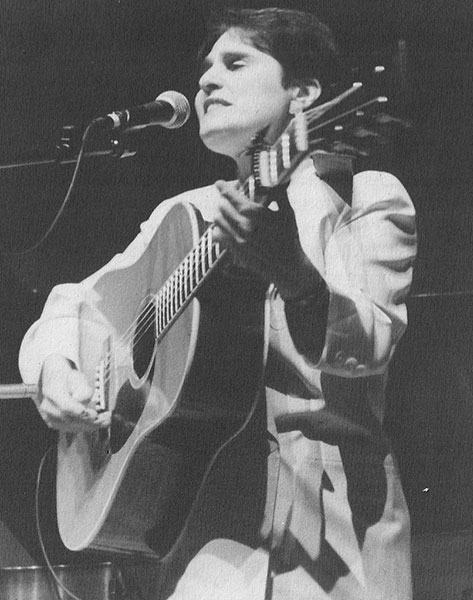
Debbie Friedman learned the wisdom and wonder of Judaism around the farmhouse kitchen of her grandparents, Eva and Bill Chernoff in Utica, New York. When she was five, her father accepted work in St. Paul, Minnesota, and the Friedmans moved 1,000 miles away. As an elementary and Hebrew school student, young Debbie struggled with reading comprehension. In time, frustration led to the conviction that she was inferior. “I really thought I was running on a deficit of intelligence,” she says, a refrain often heard from learning-disabled adults who went undiagnosed as children. Throughout her life, what she learned best, she always learned by ear. It was not until she reached her thirties that she understood that a tracking problem in her brain prevents her from arranging letters and musical notes in proper sequence. A computer synthesizer now allows her to compose on a keyboard, translating her melodies into correct time, signature, key, and form.
In high school, her gift for melody merged with her unshakable connection to an ancestral past. Ms. Friedman’s acoustic melodies are rooted in the era of Bob Dylan and Joan Baez. At age 17, she acquired her first twelve-string guitar and, without the benefit of formal musical training, began writing Jewish music. Upon her return from a post-graduation stint in Israel, she gained notice in the United States as a song leader at various Reform congregations and summer camps. Once, on a bus bound for New York, a melody came into her head. She married it to the “V’ahavta” prayer – ‘And thou shalt love the Lord thy God with all thy heart’ – and taught it to students at a conclave. “All of a sudden they stood up, grabbed each other’s arms, and joined in this prayer,” recalls Ms. Friedman. “I realized something powerful was happening.”
Through teaching and cantorial positions in Houston, Chicago, New Jersey, Palm Springs, San Diego, and Los Angeles, Ms. Friedman spent the 1970s and 1980s writing cantatas, choral works, and dozens of funny and tuneful Jewish songs for children and adults. For someone who is described as having invented a unique style of American Jewish music, Debbie Friedman is still always connected, with great humility, to her source: “I feel that what comes through me is what I was put here to do. It’s a gift, and it doesn’t belong to me.”