

By Adina Kay-Gross
Following the tumultuous and nationally divisive 2016 election, Aaron Dorfman—then president of the Lippman Kanfer Foundation for Living Torah—noticed growing concern across the organization about fractures in American democracy and communal life.
“As an institution, we recognized that American Jewish life was, in many ways, predicated on a vibrant liberal democracy,” Dorfman explained. “Liberal democracy created the container in which Jewish communities have thrived in this country—and that container was starting to feel increasingly precarious.”
During his five years at the Foundation, Dorfman focused on raising awareness about threats to democracy and supporting organizations working to sustain it. The January 6th Capitol attack deepened his sense of urgency, inspiring him to conclude his work at Lippman Kanfer and launch A More Perfect Union (AMPU), an organization dedicated to mobilizing the Jewish community in defense of American democracy.
AMPU began by forging connections. “For the first three years, we essentially had one strategy: recruit and support Jewish nonprofits,” Dorfman said. One of the first such partners was Chazaq, a Queens-based organization serving the Bukharian Jewish community by translating voter education materials into Russian.
By the end of 2024, AMPU had grown to include 200 partner organizations across 29 states. Dorfman remained focused on supporting “meaningful pro-democracy work that mattered in local communities,” much of which centered on safeguarding free and fair elections.
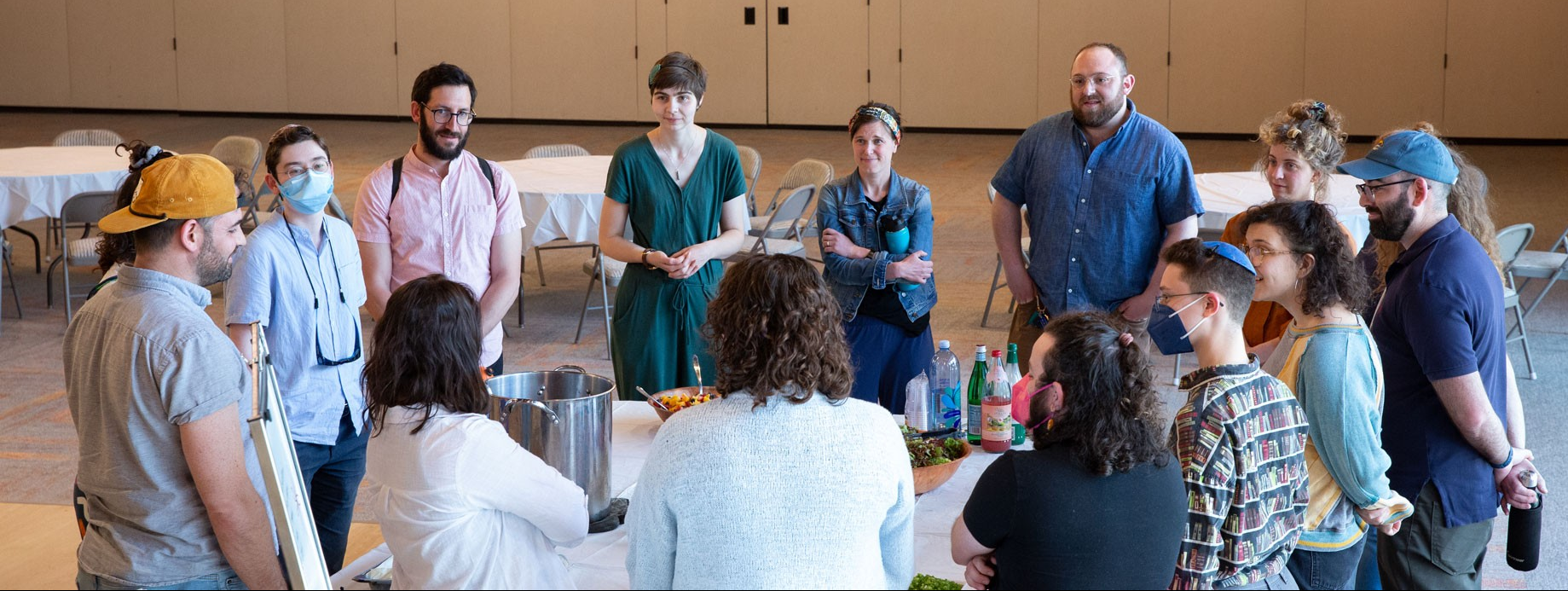
To advance this work, AMPU convened a civic learning week in Washington, D.C., bringing together 25 partners to assess the needs of the Jewish civic education field. With funding from The Covenant Foundation and the Hartman Institute, a seminar of nine Jewish scholars collaborated to articulate a set of core principles for American Jewish civics.
Dorfman sees one of the Jewish community’s greatest strengths as its deeply institutional nature. Rather than building new infrastructure, AMPU aims to make a compelling case that civic learning should be embedded within existing Jewish educational frameworks. “We want institutions to see this as essential,” he said.
He added that linking Jewish education with civic learning is a fitting response to the current state of American democracy—and that it is no coincidence that Jews have thrived in the United States as they have nowhere else. Jewish middot and civic values, Dorfman argues, are inherently aligned—a central premise of AMPU’s work.
Today, AMPU’s network has grown to 220 partners, with ambitions to expand further. Dorfman hopes to better reflect the full diversity of American Jewish life and ultimately engage 10 percent of the roughly 7,500 Jewish nonprofits nationwide.
At the heart of this effort is a curriculum designed to equip Jewish educators with tools for teaching dialogue and democratic engagement. Cultivating a culture of pluralism, Dorfman notes, is essential to both democracy and Judaism. Accordingly, AMPU’s materials emphasize tolerance and the value of diverse perspectives, drawing on Jewish texts as foundational resources. One such example is the biblical principle dina d’malchuta dina—“the law of the land is the law.”
As AMPU continues to expand its reach and deepen its impact, the organization sees the new year as an opportune time to convene educators and communal leaders to affirm a shared commitment to civil discourse and democratic values.