
Susan Werk
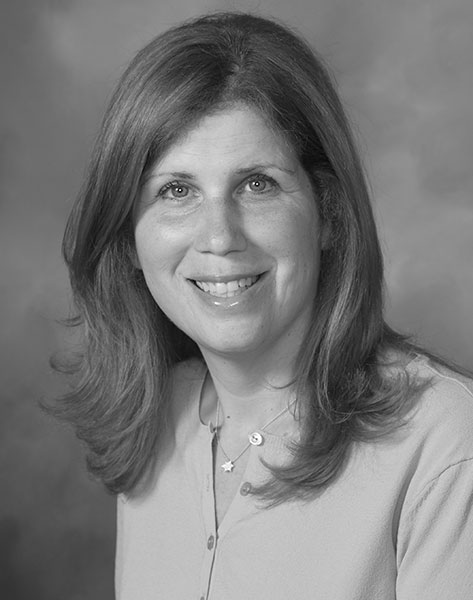
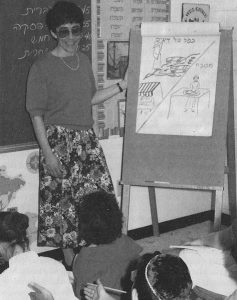
Susan Werk “In my final year at college, during my student teaching, I taught units on the Iroquois Indians to seventh-graders and Middle Eastern studies to ninth-graders. My supervisor at the school met with me after I finished my 12 weeks as a student teacher. His evaluation of my classroom skills went something like this: ‘When you teach the Iroquois Indians, your teaching is fine; however, when you teach the Middle East (the lesson he observed was on Israel) your passion can be felt.’ This remains true until today—my passion for the subject of Judaism and Israel has been woven into the fabric of my teaching.”
Susan Werk says her love of Jewish learning began early, in her family and synagogue life growing up in Spring Valley, New York. Her father, Joseph Werk, was a Holocaust survivor and a regular synagogue attendee, and he instilled in her the importance of pride in, responsibility to, and love of synagogue and faith. Her mother, Doris (z’l), embodied the third generation of American Jews, assimilated into this country’s society and accepting its values while continuing to embrace the Jewish tradition. Her mother, Susan says, had a natural spirituality, a strong personal relationship with God, but no knowledge of the Hebrew language or worship.
Lighting candles on Friday night meant not a recitation of the blessing but an open personal prayer verbalizing her gratitude and hopes. Susan sees her parents as embodying a strong and wonderful hybrid: a nonjudgmental approach to one’s relationship to God and a commitment to the well-being of the Jewish community.
Grounded by a family where Judaism was valued and valuable, it was at her synagogue school that Susan truly fell in love with Jewish education. Susan had the good fortune to have a truly incredible synagogue education director, Rabbi Phil Fields. For three years, she learned from and adored this master educator, who showed her how the melding of formal and informal Jewish education could be as natural as the blending of the European and American backgrounds in her home life. Afternoon Hebrew school and the synagogue became her second home, a place of discovery and wonder.
In 1990, Susan received her Master’s degree in Jewish Education from the Jewish Theological Seminary. While there, she also served as Division Head at Camp Ramah in the Berkshires, with which she maintains an important professional relationship. Her most treasured teacher during those years was Dr. Miriam Klein Shapiro (z’l), who impressed upon Susan the awesome responsibility we assume as educators. Teaching, Susan came to realize, is a sacred task, filled with generational ties to our past, present, and future.
Almost immediately after receiving her degree, Susan took on that task as Educational Director of Congregation Agudath Israel in Caldwell, New Jersey. She has been there ever since, creating formal and informal educational programming for congregants at all levels. She has held national leadership positions in the Jewish Education Association (JEA), the Conservative Movement Jewish Educational Assembly, and CAJE.
She also teaches for the Melton Adult Mini School and for the MetroWest Federation’s Women’s Department, and she serves as a mentor for both the Leadership Institute for Congregational School Educators through the Hebrew Union College and the Jewish Theological Seminary and for the Davidson School of Education at the Jewish Theological Seminary.
Susan has achieved recognition and accolades from every institution that she has touched. In 1996, Congregation Agudath Israel honored Susan with a testimonial dinner, and in 2002 with a weekend honoring her thirteen years as Educational Director. In 1998, for her contribution to Camp Ramah, Susan won the Camp Ramah in the Berkshires “Ramah Award”; she has also been honored with awards from the JEA and the New Jersey Association of Jewish Communal Service, and she has co-authored articles on Jewish education.
Much as she values these honors, Susan maintains that her greatest rewards have come from the work itself. She believes that teaching limudei kodesh is not something the teacher does alone; sacred education is the work of a partnership between teacher and student. The students in her life—children, teens, and adults—have given her “immeasurable riches.”